Part of my ongoing coverage of the 2026 elections and what they mean for North Padre Island.
Last week the United States Supreme Court handed down a decision that will reshape how every election in this country is run for the next decade — and probably much longer. The case is called Louisiana v. Callais. It was decided on April 29, 2026. And while it’s getting national headlines, the people who will feel it most are us — voters in South Texas, in Nueces County, and right here on North Padre Island.
I want to walk through what the ruling actually says, what it means for Texas, what it means for Corpus Christi, and what it means for the Island. Then I want to share something I noticed when I went looking at the numbers — because I think it changes how this whole conversation should be framed.
What the Court Actually Decided
The case came out of Louisiana, but the backstory is the part nobody is telling clearly enough.
A few years ago, a federal court ruled that Louisiana’s congressional map illegally diluted the Black vote and ordered the state to redraw it with a second majority-Black district. Louisiana complied. As a result, two Black members of Congress were elected from Louisiana for the first time in state history.
Then a group of self-described “non-Black” voters sued, claiming the new map was an illegal racial gerrymander — that the state had relied too much on race when it complied with the original federal court order. The case went to the Supreme Court. And on April 29, the Court sided with the second set of plaintiffs.
In plain English: Louisiana was sued for not having enough majority-Black districts. They complied. They elected Black representatives for the first time. Then they were sued again — and lost — for having complied too well.
The legal effect is that Section 2 of the Voting Rights Act — the provision that for sixty years required map-drawers to consider whether their districts diluted minority voting power — has been dramatically weakened. State legislatures now have far more freedom to draw maps for partisan advantage, as long as they don’t openly say they’re doing it because of race. As Justice Elena Kagan wrote in her dissent, this is “the latest chapter in the majority’s now-completed demolition of the Voting Rights Act.”
The National Picture in Two Sentences
Across the country, state legislatures are racing to redraw maps before the November midterms. Louisiana is already redrawing. Alabama has called a special session. Florida just signed maps that could yield four additional Republican seats. New York Democrats are now organizing to redistrict in response. Voting rights groups estimate that across ten Southern state legislatures, Republicans could gain more than 190 seats currently held by Democrats — most of them Black representatives in majority-minority districts.
This is the biggest rewrite of American electoral geography since 1965.
What This Means for Texas
Texas got there first. In the summer of 2025, the Trump administration pressured Texas Republicans to redraw the state’s congressional maps mid-decade — outside the normal once-a-decade cycle that follows the census. Governor Abbott called a special session. Texas Democrats fled the state to deny quorum. The Republican legislature eventually passed a new map designed to flip up to five Democratic-held congressional seats to Republicans.
A federal court in El Paso struck the new map down in November 2025, ruling it was an unconstitutional racial gerrymander. The Supreme Court immediately stepped in, stayed the lower court’s ruling, and in April 2026 cleared the new map for use in the 2026 midterms.
The Callais decision now makes those Texas maps essentially unchallengeable on race grounds going forward. Texas was the proof of concept. Callais made it the new normal.
What This Means for Nueces County
Here is where the abstract becomes personal. Nueces County is now split.
Under the new Texas map, downtown Corpus Christi — including the area around the bayfront, downtown businesses, the museum district, and northward — remains in the 27th Congressional District, currently held by Republican Michael Cloud.
But Corpus Christi’s Southside, all of North Padre Island, and large portions of southern Nueces County were moved into the redrawn 34th Congressional District, which now stretches all the way down to Cameron County at the Mexican border. The 34th is currently represented by Democratic Congressman Vicente Gonzalez.
According to U.S. Census data, Hispanic residents make up just over 62 percent of Nueces County. Splitting the city’s most heavily Hispanic and Democratic-leaning neighborhoods into a long, narrow district that runs to the Rio Grande Valley is not an accident. It’s a strategic choice — one that, before Callais, was being challenged in federal court as racial gerrymandering. After Callais, that challenge has almost no path forward.
The practical effect: depending on which side of the new line you live on in Corpus Christi, you may have a different congressional representative than your neighbor three streets away.
What This Means for North Padre Island
For Islanders, the answer is straightforward — and worth knowing clearly: all of North Padre Island has been moved into the new 34th Congressional District. Every Islander now shares a representative with the Southside of Corpus Christi, Kleberg County, Kenedy County, Willacy County, and Cameron County, all the way down to Brownsville at the Mexican border.
That representative is Democratic Congressman Vicente Gonzalez, who is currently running for re-election in the redrawn district.
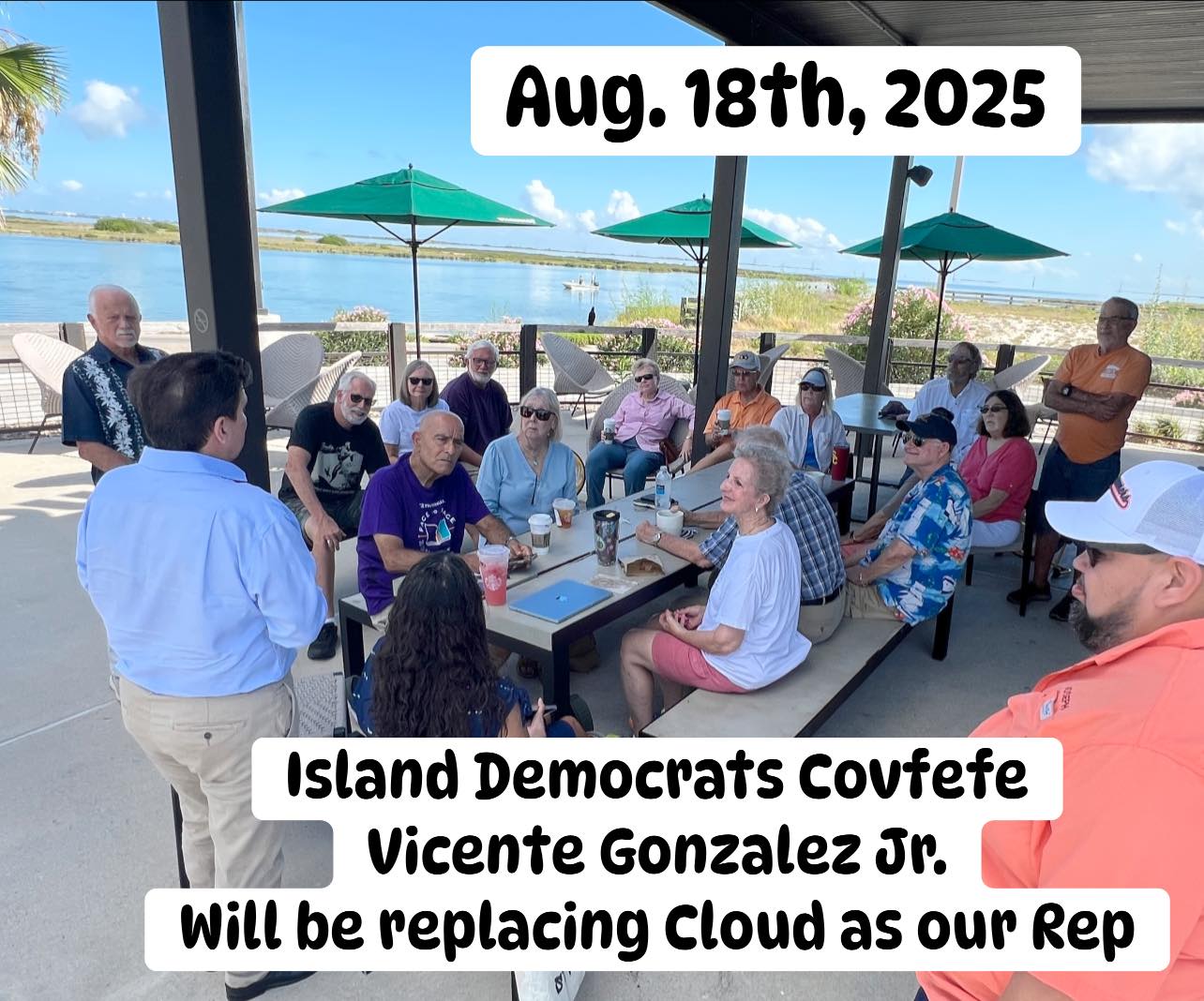
Some Islanders already know Congressman Gonzalez — he joined us at Monday Covfefe at Island Starbucks once before, sitting down with Island Democrats and hearing Coastal Bend concerns directly from constituents. The silver lining in a frustrating ruling: as of November, we will be formally represented by someone who has already shown up here, listened, and heard about our water crisis face to face. That continuity matters.
Here is what this means in practice for Island residents:
- Your congressional representative has changed. If you previously lived in the 27th District (Cloud), you are now in the 34th District (Gonzalez). The change took effect with the March 2026 primary and will be in place for the November general election.
- The Coastal Bend is now politically diluted. Splitting Corpus Christi across two districts means neither congressperson has the full Coastal Bend as their primary constituency. The Corpus Christi water crisis, hurricane preparedness, the Naval Air Station, the Port of Corpus Christi, our beaches and tourism — all become secondary concerns competing for attention against the Rio Grande Valley to the south and Victoria-area suburbs to the north.
- The 34th District is enormous and culturally diverse. An Islander on North Padre and a voter in Brownsville — over 200 miles apart — now share a congressman. We have legitimately different daily concerns. Our representative will have to balance them. We should make sure he hears from us.
- Local district maps may be next. Federal Section 2 protections that previously shaped Nueces County Commissioner precincts, justice of the peace precincts, school board single-member districts, and city council districts are now significantly weaker. Any of these could be redrawn over the next several years with much less legal scrutiny.
The Numbers That Should Stop Us Cold
Here is what I noticed when I went looking at the actual data on who serves in Congress versus who lives in this country. The picture surprised me. I think it should surprise you too.
Black Americans make up about 12.6 percent of the U.S. population. They make up 12.2 percent of the 119th Congress. Roughly proportional representation.
Hispanic Americans make up about 19 percent of the U.S. population. They make up about 11 percent of the House of Representatives. Underrepresented by about eight percentage points.
Women make up about 50.5 percent of the U.S. population. They make up 28.65 percent of voting members of Congress. Underrepresented by more than twenty percentage points.
Asian Americans make up about 6 percent of the U.S. population. They make up about 4 percent of the House. Underrepresented.
Look at that list and ask yourself a simple question. Which of those groups has had specific federal legal protection for districting under the Voting Rights Act? Just one. Black Americans. And which is the only group that has reached anything close to proportional representation in Congress?
Just one. Black Americans.
I want to be honest about the limits of this argument. Black representation in Congress was built by sixty years of organizing, civil rights movement, demographic change, and shifting public attitudes — not by districting alone. Hispanic underrepresentation has multiple causes beyond maps: lower citizenship rates, language barriers, voter registration gaps, the recent growth of Hispanic populations in many regions. Women’s underrepresentation has nothing to do with districting at all — it’s a different problem entirely.
But here is what the numbers do tell us with no ambiguity at all: the one group that achieved proportional representation in Congress is the same group that had specific federal districting protection. The mechanism worked. It was the only mechanism we had that produced that outcome for any historically excluded group in this country.
And that mechanism is the one the Supreme Court just dismantled.
What We Can Do
This is the part I want to be straight about. The federal protections we relied on for sixty years are functionally gone. They will not be coming back through federal courts. They will only be restored — if they are restored — through Congressional action that is unlikely in the current political environment, or through state-level legislation passed by states willing to act.
Ten states currently have their own state-level Voting Rights Acts that go beyond federal protections: California, Colorado, Connecticut, Illinois, Maryland, Minnesota, New York, Oregon, Virginia, and Washington. Texas is not on that list. Passing a Texas Voting Rights Act would be one of the most consequential things this state could do for its own citizens in the next decade. It would require Democrats to win majorities in the Texas Legislature — which, in turn, requires the kind of organizing we do here in precincts 40 and 81 every day.
In the meantime, three things every Coastal Bend voter should do:
- Confirm your district before November. All of North Padre Island is now in TX-34 (Vicente Gonzalez). Verify your specific address using the Texas Secretary of State’s “Who Represents Me?” tool at wrm.capitol.texas.gov.
- Vote in every election, not just the high-profile ones. Down-ballot races — county commissioner, school board, justice of the peace, city council — are where the practical effects of Callais will hit hardest over the next several cycles. Low-turnout local elections decide who sits in the rooms where these maps get drawn.
- Pay attention to who’s running for Texas Legislature in 2026. Every state legislator we elect from now on will help determine whether Texas eventually joins the ten states with their own Voting Rights Acts — or whether we don’t.
A Closing Note
The Voting Rights Act was passed in 1965 in direct response to Jim Crow voter suppression. It has been reauthorized by Congress, with overwhelming bipartisan support, every time it has come up for renewal — including as recently as 2006, when it passed the Senate 98 to 0. The Supreme Court has now effectively undone, by judicial decision, what sixty years of bipartisan civil rights consensus built through legislation.
That is what we are living through. Not a single ruling on a single case in a single state. The end of an era of federal voting rights protection that took a hundred years to build and that will take us decades more to rebuild — if we choose to.
For the Coastal Bend specifically, the ground is shifting under our feet. The least we can do is pay attention. The most we can do is organize. Right here. Precinct by precinct. Door by door. Election by election.
That is what the Island Democrats exist to do. And it matters now more than it has in a long time.
Want to get involved? Join us at Monday Covfefe at Island Starbucks (10 AM, every week), or call 361-548-6804. Voter registration help, yard signs, and runoff information are all available. Past Monday Covfefe guests have included Congressman Vicente Gonzalez — you never know who might pull up a chair. The May 26 primary runoff is two weeks away. Don’t sit it out.
More from islanddemocrats.com: Texas 2026 Primary Runoffs in Nueces County
#NorthPadreIsland #IslandDems #Precinct40 #VotingRightsAct #CoastalBend #NuecesCounty #CorpusChristi