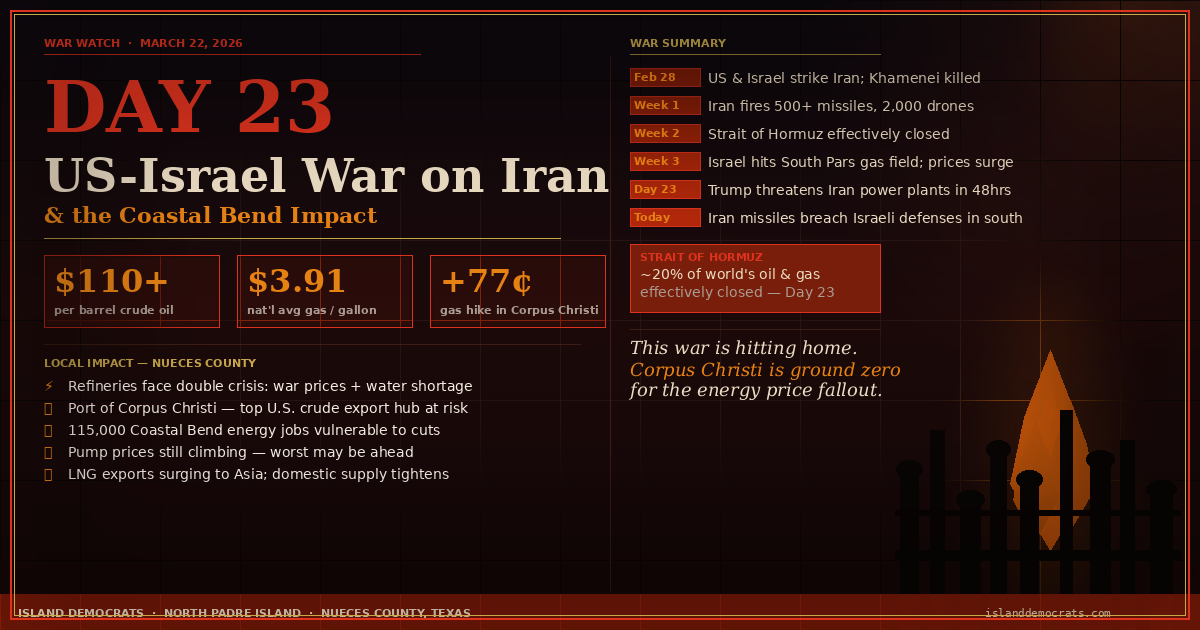
🌍 Iran War — Where Things Stand (Day 23, March 22)
How it started: The war began on February 28, 2026, when the United States and Israel launched surprise airstrikes on multiple sites across Iran, killing Supreme Leader Ali Khamenei and several other Iranian officials. Iran responded with missile and drone strikes against Israel, US bases, and US-allied countries in the Middle East. Wikipedia
Where it stands today: The war is now in its fourth week. The near-total halt of traffic through the Strait of Hormuz — the key waterway through which about a fifth of the world’s oil and liquefied natural gas typically passes — has created a catastrophic disruption in oil markets. Crude oil prices have topped $110 per barrel, up roughly 45% since the war began. NPR
Trump’s mixed signals: Trump said Saturday that Iran wants to make a deal, but he does not, arguing he’s met his goals “weeks ahead of schedule” and that the US has “blown Iran off of the map.” However, Israel’s defense minister said strikes will “increase significantly” this week. CNN
Latest escalation: Trump threatened to “obliterate” Iran’s power plants if Tehran does not fully reopen the Strait of Hormuz within 48 hours. Meanwhile Iranian missiles struck the Israeli cities of Arad and Dimona, wounding nearly 100 people and breaking through Israel’s air defenses. Al Jazeera
Casualties: In Iran, more than 1,330 people — including at least 200 children — have been killed and over 18,000 injured. In Israel, more than 4,292 people have been hospitalized since the war began. CNN
Gas prices nationally: Gas prices hit a nationwide average of $3.91 per gallon on Friday, up 93 cents from February 28 when the conflict began. CNN
🏭 How This War Hits the Corpus Christi Area
This is where it gets very local and very real for Coastal Bend residents:
⛽ Gas prices already up sharply As of March 11, the Corpus Christi average was $3.37 per gallon — up 77 cents from before the war began. That figure has almost certainly climbed further in the 10 days since. KristV
🏗️ Refineries under double pressure Corpus Christi refineries are now caught in a dangerous squeeze — gasoline prices are rising due to the Iran war while simultaneously facing the local water crisis. Industry officials warn that if water limits force changes, “facilities might have to slow production, take units offline or run at lower rates,” which would hit local jobs, reduce economic activity, and cut into revenue flowing through the Port of Corpus Christi. Click2Houston
🛢️ The Port is critically important — and vulnerable The Port of Corpus Christi is one of the country’s leading crude oil export points, and any disruption to refining and export sites could tighten supplies of gasoline, jet fuel, diesel, and other refined products across all of Texas. Click2Houston
📈 LNG opportunity — but at a cost Asian nations are surging demand for U.S. energy as they seek alternatives to Middle Eastern fuel. Freight rates for U.S. liquefied natural gas shipments have more than quadrupled, and LNG cargoes are being redirected away from Europe toward Asia — which benefits Corpus Christi LNG exporters but tightens domestic supply. KristV
💼 Jobs and economy at risk The water crisis + war combination creates a worst-case scenario for Coastal Bend workers. If refineries cut production due to water shortages, that directly impacts the roughly 115,000 oil and gas industry jobs in the Coastal Bend region.
🏠 Cost of living squeeze Every Corpus Christi resident is feeling it at the pump, and rising fuel costs are filtering through to food prices, delivery costs, and utilities — hitting working families hardest.
Bottom line for Island Democrats: This is a major organizing issue. The war is driving gas prices through the roof, threatening refinery jobs, and compounding the already-serious water crisis — all at the same time. Working families in Nueces County are being hit from multiple directions at once.