Coastal Bend Water Watch · Corpus Christi, Texas · March 18, 2026
A $600 Million Gamble on Flour Bluff’s Waterfront
May 8, 2026 Update: In the seven weeks since the Council voted on the Flour Bluff desalination partnership with CPS Energy, the broader water crisis has worsened — combined reservoir capacity has fallen to 8.7%, and the City is now projecting a Level 1 Water Emergency by September 2026. The Council recently delayed the vote on emergency restrictions that would limit residents to 5,250 gallons per month. Meanwhile, residents are increasingly asking why a $600 million desalination commitment cannot be matched by faster action on conservation, leak repair, and decentralized solutions like atmospheric water generation. The Flour Bluff desal plant remains years away from producing usable water — so what bridges us until then?
Wednesday, March 19, 2026 · Water & Infrastructure
City Council votes to partner with CPS Energy on seawater desalination at Barney Davis Power Plant — promising drought-proof water for the region, but raising hard questions for the community that would bear the costs.
Coastal Bend Report Staff
Flour Bluff / Corpus Christi · Water & Environment Desk
Updated 7:45 a.m. CT, March 19, 2026
Breaking · Water Crisis
In a unanimous vote Tuesday, the Corpus Christi City Council authorized staff to partner with CPS Energy of San Antonio to explore a seawater desalination facility at the Barney Davis Power Plant in Flour Bluff — a site that water planners have studied, debated, and shelved for more than two decades. This time, city leaders say, the drought is too severe to wait any longer.
With combined lake levels at Choke Canyon and Lake Corpus Christi at historic lows — and the city under drought restrictions for the better part of the past year — what was once a “future backup option” has become an urgent conversation. The public comment period alone ran more than two hours Tuesday, and at least two speakers were escorted out by police before it was over.
A Plant With Deep Roots — and Deep Pockets Required
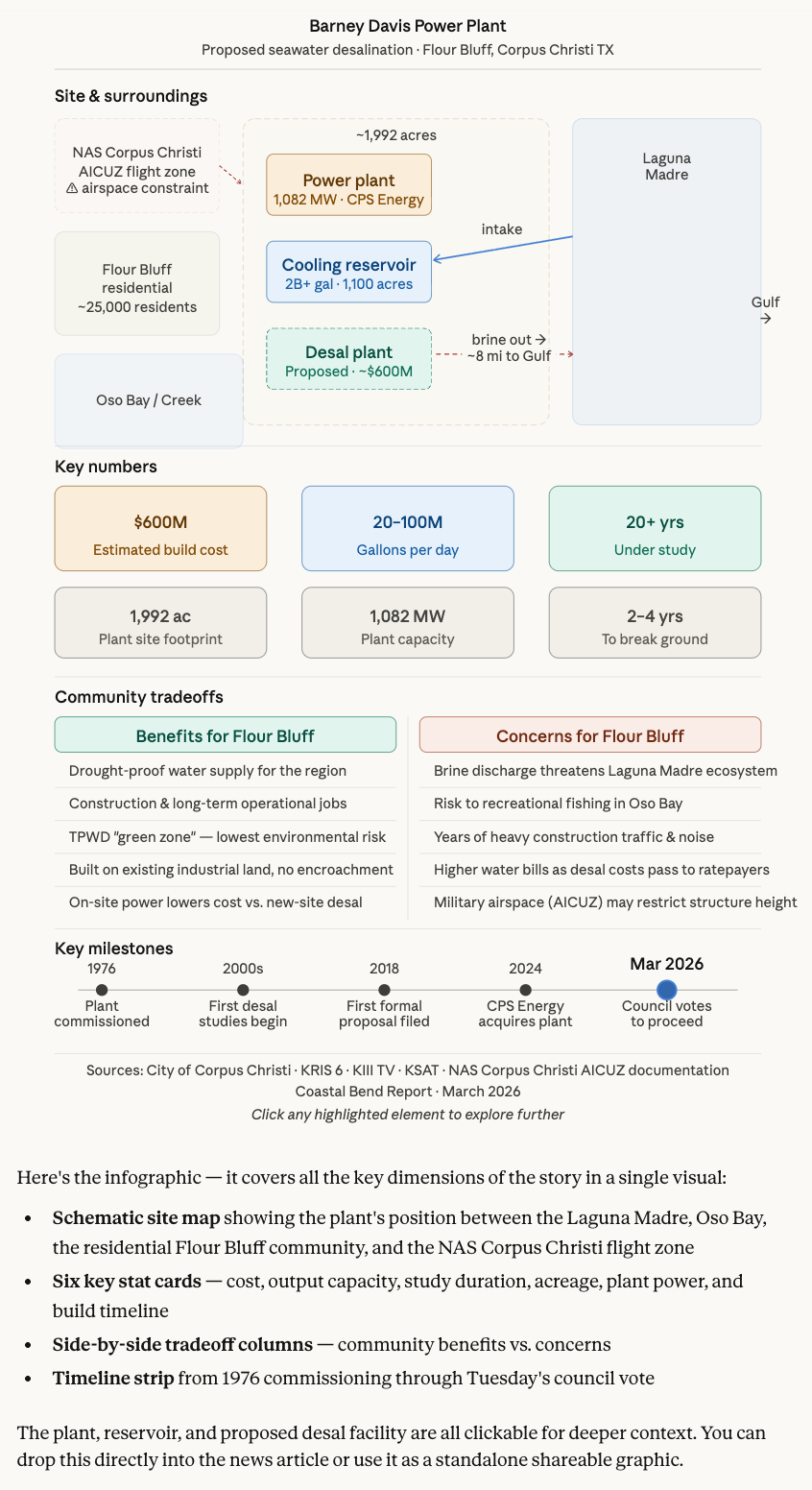
The Barney M. Davis Power Plant has anchored the Flour Bluff peninsula since its first units came online in 1974, with the facility fully commissioned by 1976. It sits on nearly 2,000 acres between the Laguna Madre and Oso Creek — one of the largest industrial footprints in Nueces County. The plant changed hands from Talen Energy to CPS Energy in 2024 as part of a $785 million deal, giving San Antonio’s public utility control over nearly 900 megawatts of generation capacity on the Corpus Christi coast.
What makes Barney Davis uniquely attractive for desalination isn’t just its size. The plant already pulls seawater from the Laguna Madre to cool its generators, storing that water in a 1,100-acre cooling reservoir built in 1973 that holds more than 2 billion gallons. In theory, a desalination facility could be bolted onto infrastructure that already exists — avoiding the enormous cost of building new seawater intake systems from scratch.
“There’s already power there — that’s one very positive thing, and that’s always been the appeal.”
— Corpus Christi City Councilman Roland Barrera
Texas Parks and Wildlife has reportedly identified the site as being in the environmental “green zone” — the most favorable coastal location for a desal project in the region. That endorsement has carried significant weight in planning circles, even as the project has stalled through multiple cycles of study and delay.
Why It Never Got Built Before
The honest answer is that for most of the past two decades, Corpus Christi simply didn’t need it badly enough to justify the cost. Former City Council member Kevin Kieschnick has said plainly that industrial demand was lower, existing water sources were meeting regional needs, and the economics never penciled out. A desalination plant of this scale requires a staggering capital investment and continues to cost tens of millions of dollars per year in operations — primarily because removing salt from seawater is extraordinarily energy-intensive.
- 1973–76 Cooling reservoir built; power plant commissioned. Seawater intake from Laguna Madre established.
- 2000s Barney Davis first appears in Coastal Bend Regional Water Plans as a long-term desalination option. Studies begin but stall over cost and lack of urgency.
- 2018 Corpus Christi Civic Leadership Group submits desalination proposal for the site. No action taken.
- 2023 Severe drought conditions drive renewed interest. City explores Barney Davis as a third potential desal site alongside Inner Harbor and La Quinta Channel.
- 2024 CPS Energy acquires the plant from Talen Energy. New ownership opens door to city partnership discussions.
- Mar. 2025 Engineering firm CDM Smith submits updated proposal for the site.
- Feb. 2026 City staff meets with CPS Energy representatives to formally discuss development options.
- Mar. 18, 2026 City Council unanimously approves motion to move forward with CPS Energy partnership exploration.
What It Means for Flour Bluff
For the community that would live alongside it, the picture is genuinely mixed. The plant offers a meaningful long-term benefit — a drought-resistant water supply that doesn’t depend on rainfall in the Hill Country. But Flour Bluff would bear a disproportionate share of the industrial burden and ecological risk compared to the rest of Corpus Christi.
Community Benefits
- Drought-proof regional water supply produced locally
- Construction and long-term operational jobs in the area
- Site already in environmental “green zone” per TPWD
- Expansion within existing industrial footprint — no new land encroachment
- Existing power and seawater infrastructure reduces build costs
Community Concerns
- Brine discharge risk to the Laguna Madre ecosystem
- Threats to recreational fishing in Oso Bay and surrounding waters
- Years of heavy construction traffic and industrial disruption
- Higher water bills as desalination costs are passed to ratepayers
- Decades of permitting limbo with no guarantee of completion
The Laguna Madre Question
Of all the environmental concerns, brine disposal looms largest. Desalination produces a concentrated saltwater byproduct laden with chemical residuals from the treatment process — and disposing of it responsibly is one of the most technically and regulatorily complex aspects of any coastal desal project. The Laguna Madre, already among the saltiest lagoons in the world, is particularly vulnerable. Adding hypersaline brine to an already hypersaline system could stress the seagrass beds and marine habitats that make the area one of the most productive fisheries on the Texas coast.
City Manager Peter Zanoni has made clear that any approved project would require brine to be piped out into the Gulf of Mexico rather than discharged into the bay system — a condition that would require its own environmental permits and an undersea pipeline running roughly eight miles offshore. That’s not a small addendum. It’s a major infrastructure undertaking in its own right.
A Wildcard Few Are Talking About: Military Airspace
⚠ Regulatory Flag
The Barney Davis site sits within a heavily militarized airspace corridor anchored by NAS Corpus Christi’s Truax Field and NOLF Waldron — both located on the Flour Bluff peninsula. The Navy’s Air Installation Compatible Use Zone (AICUZ) framework establishes height restrictions and accident potential zones across much of the area.
Any new tall structures — cooling towers, processing stacks, or elevated infrastructure — built as part of a desal expansion could require Navy coordination and sign-off before construction permits are issued. City officials say they are proceeding carefully to avoid jeopardizing existing permits at the power plant, but a formal desal expansion triggers new permit reviews that could invite scrutiny from the Navy’s liaison office.
This issue has received little public attention, but it could shape both the timeline and the physical design of any facility. The Navy has previously opposed development in Flour Bluff on AICUZ grounds, and a major industrial expansion in the flight training corridor over the Laguna Madre would likely draw formal comment from NAS-CC during any federal environmental review.
What About Home Values?
For the roughly 25,000 residents of Flour Bluff, one of the most immediate practical questions is what this does to property values. Research on industrial plant proximity consistently shows that the measurable impact on home values is concentrated within about a half-mile of a facility, with effects fading rapidly beyond one mile. The Barney Davis site’s nearly 2,000-acre footprint provides a natural buffer between the plant and most residential neighborhoods.
The bigger real estate risk, according to research, isn’t the plant itself — it’s what happens to the water. Studies show that proximity to pollutant discharge sites has a significant negative effect on surrounding home values, and any deterioration of the Laguna Madre’s water quality or recreational fishing access could have ripple effects well beyond the industrial buffer zone. Conversely, in a region already wrestling with severe water restrictions, a reliable local water supply could prove to be a long-term stabilizing force for property markets.
📋 What Happens Next
City staff will now begin formal collaboration with CPS Energy to develop project options. No construction has been authorized, and no timeline has been set.
Any project moving forward would require: environmental impact assessment, Texas Commission on Environmental Quality permits, federal Army Corps of Engineers review, Navy AICUZ compatibility review, funding approvals (potentially including state and federal grants), and a public-private partnership agreement under a “take-or-pay” water contract model.
City Councilman Barrera estimates two to four years before any groundbreaking could occur under an optimistic scenario. The city is also considering forming a public utility authority to help finance and manage the project.
“We can’t do them all, but you also don’t want to leave any stones unturned.”
— Corpus Christi City Council member, on the multi-front water strategy
For now, what Tuesday’s vote signals is less a decision than a declaration of intent: that Corpus Christi is finally serious about the Barney Davis site, that the drought has changed the political calculus, and that the question is no longer whether desalination belongs in the city’s water future — but whether Flour Bluff will be the place it happens, and on whose terms.
Sources: KRIS 6 News, KIII TV, KSAT, Corpus Christi City Council meeting records, City of Corpus Christi official press release, Global Energy Monitor, Power Technology, U.S. Navy AICUZ documentation (NAS Corpus Christi), peer-reviewed research via PubMed Central and MDPI, Coastal Bend Regional Water Plan.
This article was compiled from public records, council meeting coverage, and regional water planning documents. It does not represent the editorial position of any named publication.