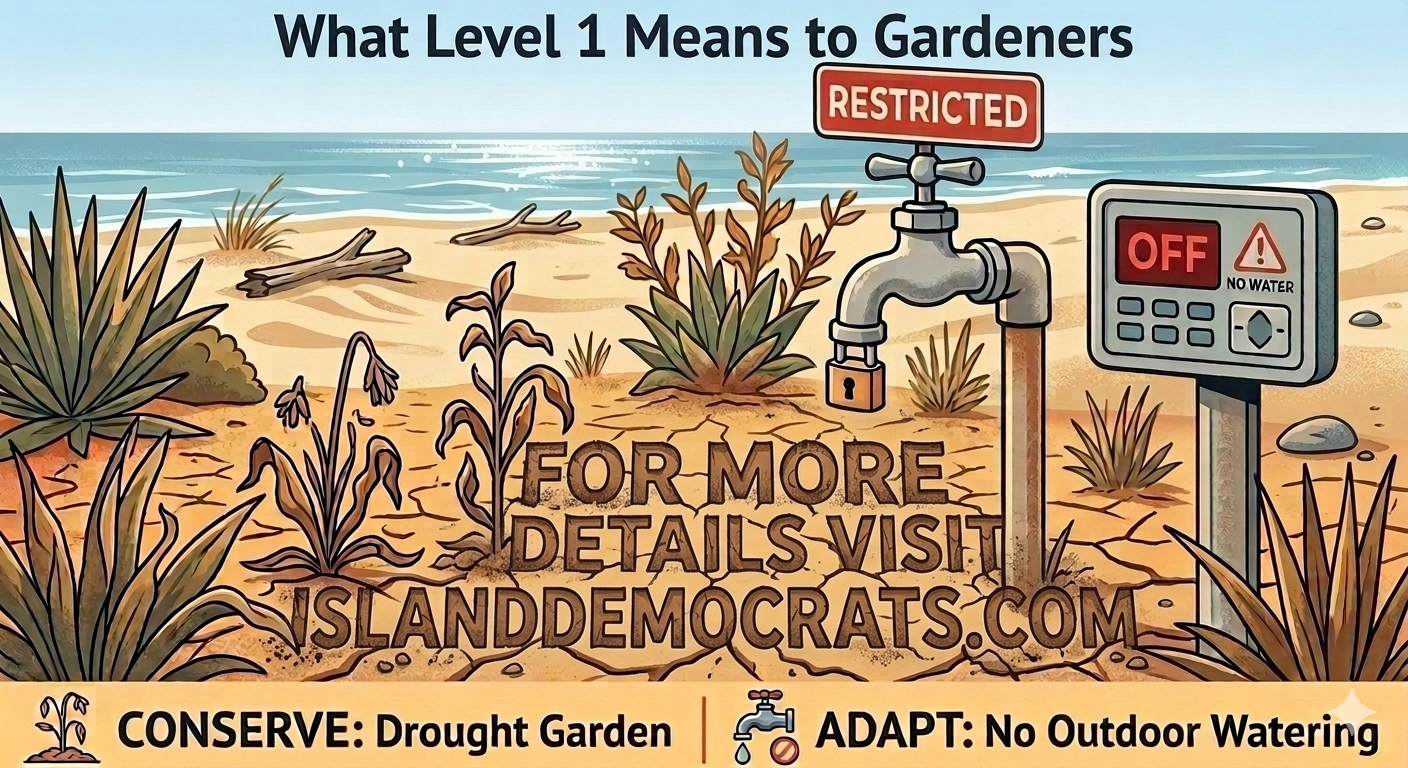
First, can you use sprinklers to water your garden? Currently, no. Under the Stage 3 restrictions already in place, you cannot use sprinklers or irrigation systems.
Current Watering Rules (Stage 3)
- No Sprinklers: The use of automatic irrigation systems and hose-end sprinklers is prohibited.
- Hand-Watering Only: You can only water your garden using a hand-held hose with a shut-off nozzle or a hand-held bucket.
- Watering Times: Even when hand-watering, you must do so before 10:00 AM or after 6:00 PM.
What Changes in Level 1?
If the city moves to a Level 1 Water Emergency (potentially as early as May or June), the rules get even stricter:
- Total Outdoor Ban: All landscape irrigation with potable water becomes prohibited, including hand-watering.
- The Exception: During a Level 1 Emergency, you may only use reclaimed water (treated wastewater) or greywater (like bath or dish water) for your garden, provided it doesn’t run off into the street.
Yes, there is currently an allowance for food-producing gardens, but it does not include the use of sprinklers.
Current Stage 3 Rules for Food Gardens
Under the current Stage 3 restrictions, you can water vegetable gardens and fruit trees using potable water under these conditions:
- Method: You must use a hand-held hose with a positive shut-off nozzle, a bucket, or a watering can (5 gallons or less).
- Timing: Watering is only allowed before 10:00 AM or after 6:00 PM on any day of the week.
- Prohibited: Sprinklers, irrigation systems, and soaker hoses remain banned for all landscape and garden use.
Exemptions and Variances
While “food-producing gardens” are listed as a category on the city’s Exemption/Variance Application, these are typically reserved for:
- Commercial Operations: Large-scale food producers or nurseries.
- Hardship Cases: Residents who can prove that the current hand-watering rules will cause “unnecessary hardship” or significant property damage.
What Happens in a Level 1 Emergency?
If the city enters a Level 1 Water Emergency, the rules for food gardens are expected to tighten significantly:
- Potable Water Ban: The use of tap water for any outdoor irrigation, including vegetable gardens, is prohibited in the standard Level 1 plan.
- Alternative Water Sources: To keep a garden alive during Level 1, residents must switch to greywater (recycled household water) or reclaimed water (treated wastewater).
- Note on Reclaimed Water: The city offers reclaimed water for free at the Oso Water Reclamation Plant, but it is explicitly labeled as non-potable and is generally recommended only for non-edible plants unless you have a specific filtration setup.
To discuss a hardship variance for your garden or get clarification on specific drought rules, you can contact the city’s dedicated water resources team:
- Water Resource Hotline: 361-826-1600
- General City Services: Dial 3-1-1 (within city limits) or 361-826-2489
- Email for Drought Inquiries: drought@cctexas.com
How to Apply for a Variance
If you need to request a formal exemption (e.g., to use a specific watering method for a food garden due to physical disability or other “unnecessary hardship”), follow these steps:
- Get the Form: You can download the “Request for Exemptions and Variances” form from the Corpus Christi Water website.
- Detail Your Hardship: The city considers applications on a case-by-case basis. You must explicitly explain why enforcing the current Stage 3 restrictions (no sprinklers, hand-watering only) would cause “unnecessary hardship, damage, harm, or be a threat to health and safety.”
- Submission: Completed forms can be emailed to the drought address above or mailed to:
Corpus Christi Water Utilities Department
2726 Holly Rd.
Corpus Christi, TX 78415
Alternative: Reclaimed Water Filling Station
If a variance is not granted, you can still water your garden (including with sprinklers) if you use reclaimed water instead of potable tap water. The city provides this at no cost to residents who obtain a permit.
- Location: Oso Water Reclamation Plant, 4002 Holly Rd.
- Requirement: You must bring your own container or tank to haul the water yourself.
To use the city’s reclaimed water for your garden, you must first obtain a free Reclaimed Water User Permit and provide your own transportation for the water.
How to Get a Permit
You can apply for the permit in person at the Oso Water Reclamation Plant.
- Location: 4002 Holly Road, Corpus Christi, TX 78411.
- Requirements: You must bring a valid Texas Driver’s License and a recent Corpus Christi Water utility bill to prove residency.
- Training: A brief 5-10 minute safety briefing is usually required upon your first visit to explain how to handle non-potable water safely.
Filling Station Operating Hours
Once you have your permit, you can visit the residential filling station during the following times:
- Monday – Friday: 8:00 AM – 5:00 PM
- Saturday: 8:00 AM – 12:00 PM
- Sunday: Closed
Important Guidelines for Your Garden
- Container Requirements: You must bring your own leak-proof containers (totes, drums, or tanks). Most residents use 55-gallon drums or 275-gallon IBC totes.
- Weight Warning: Remember that water weighs about 8.3 pounds per gallon. Ensure your vehicle or trailer can safely handle the weight (e.g., 100 gallons is over 800 lbs).
- Labeling: All containers used for reclaimed water must be clearly labeled as “NON-POTABLE WATER” to prevent accidental drinking.
- Food Safety: While the city allows reclaimed water for “landscape irrigation,” experts recommend avoiding direct contact with the edible parts of plants (like lettuce or strawberries). It is best used for fruit trees or via drip irrigation at the base of vegetable plants.
Simple gravity-fed drip system for your food garden using these reclaimed water tanks
Setting up a gravity-fed drip system is the most efficient way to use hauled reclaimed water because it delivers moisture directly to the roots and minimizes the risk of the water touching the edible parts of your plants.
Materials Needed
- Storage Tank: A 55-gallon drum or 275-gallon IBC tote (available at many local farm supply stores).
- Elevated Stand: Sturdy cinder blocks or a wooden platform. You need at least 2–3 feet of height to create enough pressure for the water to flow.
- Bulkhead Fitting & Valve: To connect a standard garden hose to your tank.
- Drip Tape or Soaker Hose: Low-pressure drip tape works best for gravity systems.
- Fine Mesh Filter: Essential to prevent sediment from the reclaimed water from clogging your emitters.
Simple Setup Steps
- Elevate the Tank: Place your tank on the stand. For every foot of elevation, you gain about 0.43 PSI of pressure. A 3-foot height is usually enough for a small garden bed.
- Install the Outlet: If your tank doesn’t have one, install a bulkhead fitting near the bottom. Attach a simple on/off ball valve and a filter.
- Lay the Lines: Run a “header” pipe or garden hose from the tank to your garden. Connect your drip lines or soaker hoses to this header.
- Keep it Level: Gravity systems struggle with hills. Ensure your garden beds are at the same level as or lower than the base of the tank stand.
- Manual Operation: Since there is no city water pressure, you simply open the valve when you want to water and close it when finished.
Food Safety Tip
Since you are using reclaimed water, avoid overhead spraying. Keep the drip lines on the soil surface or buried under a layer of mulch. This ensures the water stays at the roots and doesn’t splash onto your vegetables.
#CorpusChristi #CorpusChristiTX #CCTX #CoastalBend #SouthTexas #Vivacc #CorpusChristiWater #CCTexas #SaveWaterCC #TexasDrought #CorpusChristiDrought #NuecesCounty #CoastalBendGardening #CCGardening #DesalCC #CorpusWaterCrisis #WaterEmergency #WaterRestrictions #Stage3Restrictions #CorpusChristiFoodies #GrowYourOwnCC #CCLocal #CorpusChristiEvents #PortOfCorpusChristi #ChokeCanyon #LakeCorpusChristi #TexasWater #CCCommunity #CorpusChristiStrong #CoastalBendLiving