Also see Gardening Level 1 Water Crisis Update
This is not a natural disaster story. It is a political failure story for North Padre Island, Corpus Christi, the Coastal Bend, actually all of Texas! It’s one that spans more than a decade, involves decisions made at the local, state, and federal levels, and implicates some of the biggest corporations on earth.
 THE ROOT CAUSE: Overselling Water to Industry (2010–2017)
The crisis has its roots in the shale oil revolution. After Congress lifted the oil export ban in 2015, huge terminals went up to load shale oil and gas onto ocean-going freighters on the coast. The Texas Observer The Port of Corpus Christi became one of the nation’s top crude oil export hubs almost overnight. City and port leaders saw an economic opportunity and aggressively courted some of the largest industrial companies in the world.
The city had already used up the resources laid out in its 50-year water plan 13 years ahead of schedule. The Texas Observer That should have been a warning sign. Instead, city leaders kept making water promises they didn’t have the supply to back up.
The defining moment came in 2017. In March 2017, then-city manager Margie Rose sent a letter to ExxonMobil, the world’s largest private oil company, that said “because the City aggressively protects water resources for the future by implementing a matrix of supply strategies, we feel that we have sufficient water supplies to meet your needs.” Six days later the city requested funding from the Texas Water Development Board to study feasibility and do preliminary design of a seawater desalination plant. The Texas Tribune
Read that again. The city told ExxonMobil it had the water. Then six days later went to the state asking for help figuring out how to get more water. On one hand, city officials were telling one of the largest oil companies on Earth don’t worry, we’ve got the water. On the other hand, they were going to the state, asking for help and figuring out how to create an entirely new water supply. Lonestarleft
When Steel Dynamics came seeking water in 2018, Corpus Christi offered another 6 million gallons a day, citing “plans for additional water sources in the planning and implementation phase.” But that wasn’t exactly true. Inside Climate News
 THE PROMISES KEEP COMING: Industrial Boom (2018–2022)
The industrial buildout accelerated. A huge plastics manufacturing facility co-owned by ExxonMobil and Saudi chemicals company SABIC, and a steel mill owned by Steel Dynamics, both opened in 2022 and were collectively promised tens of millions of gallons of water a day. CNN
Gulf Coast Growth Ventures, the plastics production facility operated by ExxonMobil and Saudi Arabia, started operations in 2022 and became the largest water consumer in the Corpus Christi region. Texas Standard ExxonMobil’s plant alone can use roughly as much water as all the residents of Corpus Christi combined.
Meanwhile the warning signs were being ignored. Encarnacion Serna, a retired chemical plant operations manager and engineer who had worked on reverse osmosis water systems for Valero and Occidental Chemical, reviewed desalination project applications and found flimsy assumptions, unrealistic estimates and missing information. “I’ve been trying since 2020 to let them know how catastrophic this is going to be,” he said. The Texas Tribune
The region was also seeing a surge of additional industry. Valero and Flint Hills expanded their refineries. Cheniere Energy built the region’s first export terminal for liquified natural gas. Voestalpine built a plant that makes iron briquettes. Three huge crude export terminals cropped up on the bay. KIII TV All of them needing water. None of the promised new supply coming online.
 THE DESALINATION PROMISE FALLS APART (2017–2025)
According to the plan presented in 2019, the state’s first desalination plant needed to be running by early 2023 to safely meet industrial water demands that were scheduled to come online. But Corpus Christi never got it done. The Texas Observer
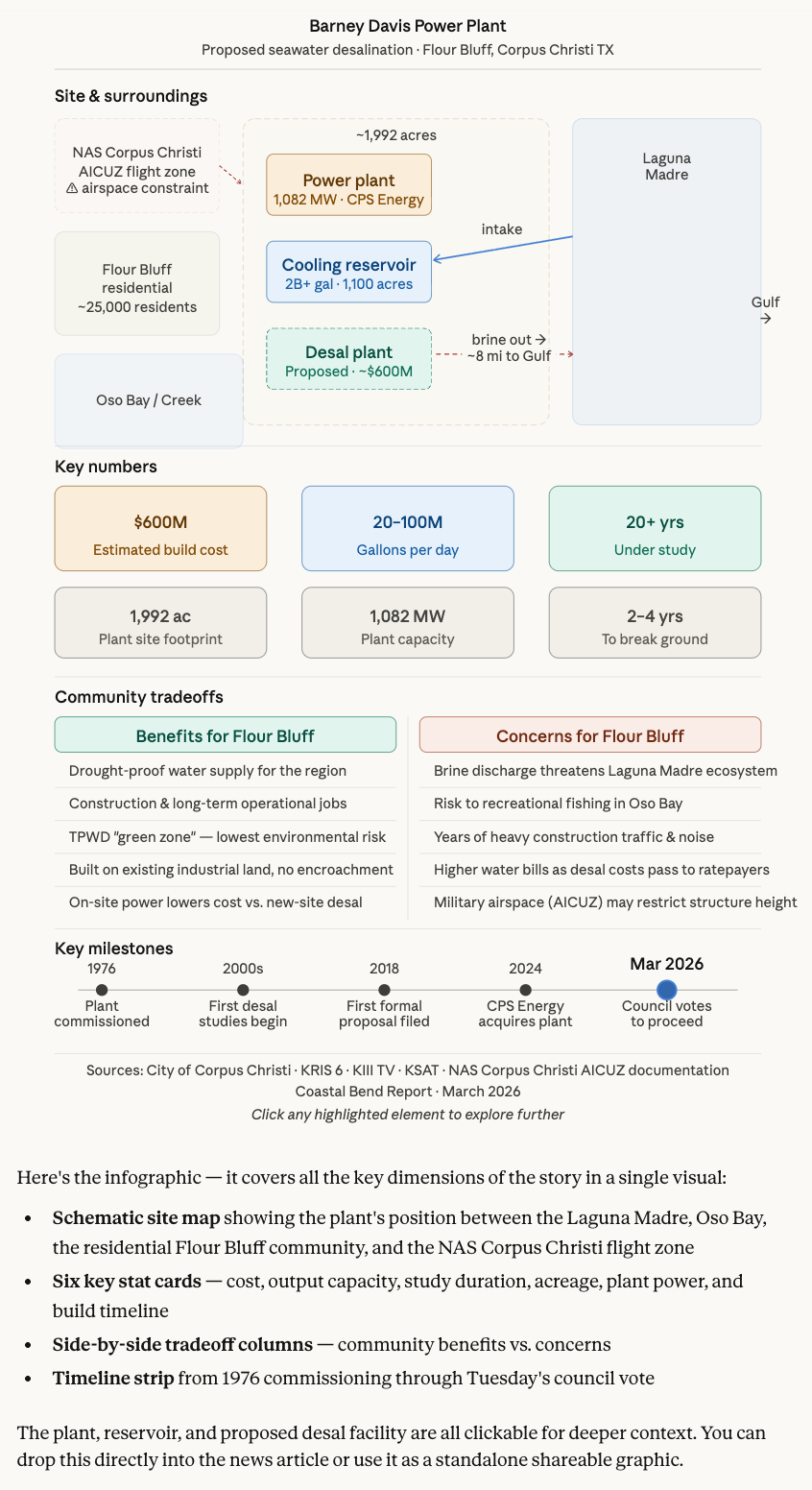
The project became mired in regulatory, environmental, and political battles. Desalination plans remained years away from completion, hung up on questions from state and federal environmental regulators — the Texas Commission on Environmental Quality and the U.S. Environmental Protection Agency — over the ecological consequences of dumping hundreds of millions of gallons of salty brine per day into Corpus Christi Bay. CNN
By 2024, the estimate jumped to $550 million. Then it climbed again to $760 million. And by July 2025, the project’s projected cost had ballooned to roughly $1.2 billion. Political support collapsed almost as quickly as the price tag grew. Council members who had once supported desalination began backing away. Lonestarleft
Then came the vote that will define this era of Corpus Christi politics. After hours of public testimony, heated debate, and several arrests in the audience, the Corpus Christi City Council voted against advancing what would have been the city’s most expensive infrastructure project to date: the $1.2 billion desalination plant at the Inner Harbor. The pivotal decision came with the rejection of Amendment 5, which would have allowed contractor Kiewit to move forward with design plans. By voting down the amendment, the council effectively halted years of planning and left the city on the hook for $122 million in debt service over the next decade — without a desalination plant to show for it. KristV
 WHO MADE THE DECISIONS: The Political CHAIN
Local Level — City Council and City Management
City Manager Margie Rose made the original promise to ExxonMobil in 2017 without the water supply to back it up. City Manager Peter Zanoni has overseen the descent toward water depletion since 2019 and receives a $400,000 salary. Former city employees and residents say the crisis has been fueled by a long list of political fights locally over the right solutions, poor long-term planning despite repeated warnings and several delayed or canceled water solutions. The Texas Tribune
Also central to the political fight is who should pay for acquiring new supplies. Because over half of the city’s water supply is used by industries, local organizers question why the city’s residential consumers should pay higher water rates to solve a problem they didn’t create. Texas Public Radio
State Level — Governor Abbott and the Texas Legislature
In January 2016, Abbott traveled to Israel, where he toured the world’s largest seawater desalination plant and met with Israeli officials to discuss desalination. The Texas Tribune He was aware of the problem a decade ago. Yet no meaningful state mandate or legislation forced the city to act.
The Texas Water Development Board provided $757 million in low-interest loans for desalination — which the city killed. Abbott is now criticizing the city for squandering that money while himself having been in office throughout the entire period of inaction. Abbott’s criticism leaves out some important context. The governor’s reference to $750 million was not a direct state grant but largely a set of state-backed loan commitments tied specifically to desalination. Texas Public Radio
Federal Level — Congress and the Oil Export Ban
Congress’ lifting of the oil export ban in 2015 made Corpus Christi the nation’s top port for crude exports Inside Climate News and set off the industrial boom that drove water demand to unsustainable levels. That decision at the federal level created the economic pressure that local politicians responded to by making water promises they couldn’t keep.
Industry — ExxonMobil, SABIC, Steel Dynamics, Valero, Flint Hills, Cheniere
ExxonMobil, along with Saudi Arabia-based SABIC, jointly operates a plastics manufacturing facility in nearby San Patricio County. The three facilities owned by the two companies are among the largest volume users of Corpus Christi’s municipal water supply. The region’s refining capacity is close to 1 million barrels of refined products per day, including 450,000 barrels of gasoline, or about 5% of the nation’s supply of refined products. The Texas Tribune
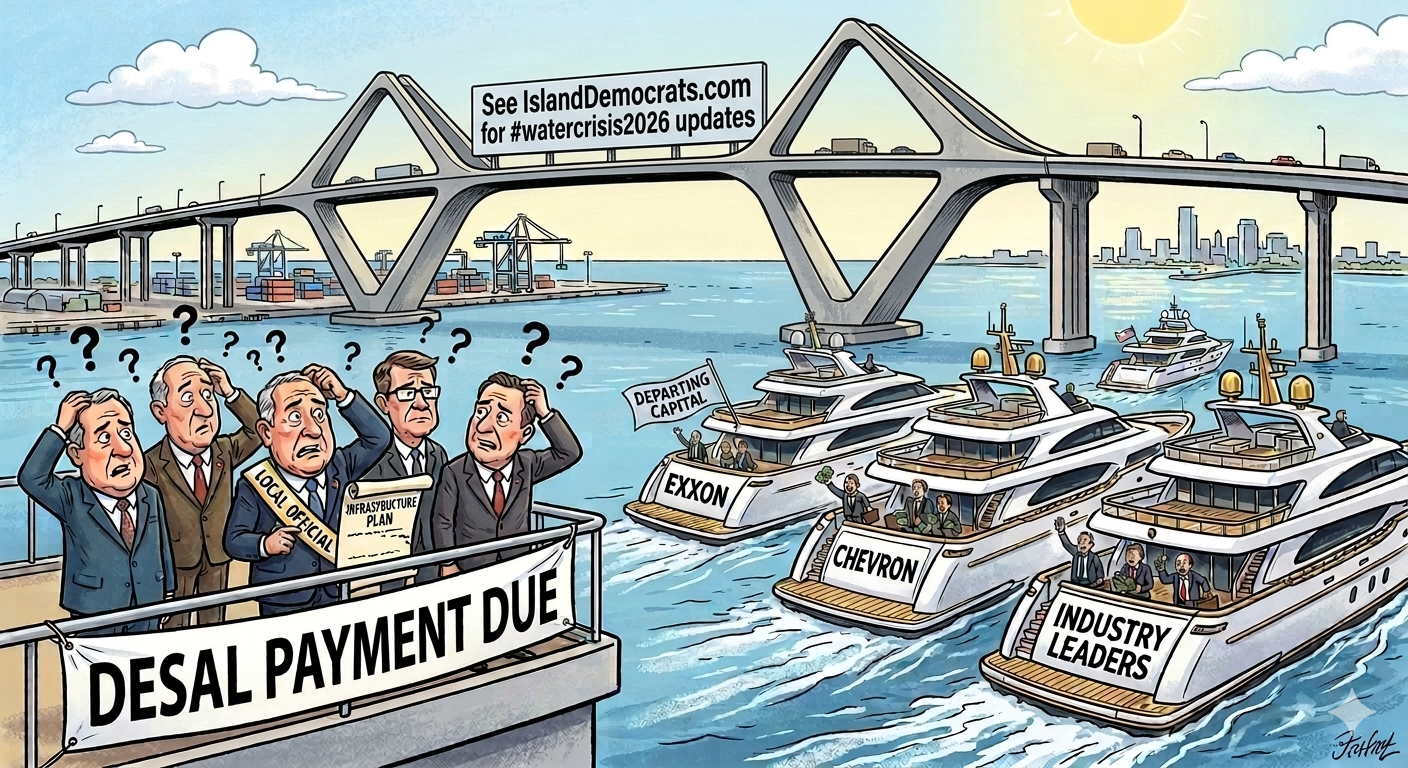
These companies accepted water promises from city officials and built billion-dollar facilities on the assumption that water would be available. Now they are scrambling for alternative sources — but for years they benefited from a city government that prioritized their expansion over securing a sustainable water supply.
 THE BOTTOM LINE
The problem was not awareness. It was execution. Corpus Christi had viable options to expand its water supply, but those options were not implemented in time. Leaders publicly projected confidence that desalination could be built quickly, even as technical, environmental, and regulatory realities made that timeline unrealistic. Texas Policy Research
At its heart, the situation in Corpus Christi highlights what happens when an industrial boom rubs up against the reality of the climate crisis and its increasingly stark impacts on water resources. “They promised all this water without having the water,” said Araiza. CNN
The residents and small businesses of Corpus Christi — including every family on North Padre Island — are now being asked to cut their water use by 25% and potentially face service termination, while the multinational corporations whose expansion drove this crisis continue operating at full capacity. That is the political reality Island Democrats should be talking about loudly and clearly.
#CorpusChristiWaterCrisis #WaterCrisis #NuecesCounty #CoastalBend #NorthPadreIsland #CCTx #TexasDrought #CorporateAccountability #ExxonMobil #BigOil #PeopleOverProfit #EnvironmentalJustice #April9 #IslandDemocrats #TexasDemocrats #TurnTexasBlue #LocalPolitics #TexasPolitics #WaterRights #WaterIsLife #ProtectOurWater #CoastalBendStrong