Island Democrats | April 2, 2026 | Corpus Christi, Texas
Also see: Gardening Specific
The water crisis facing Corpus Christi is moving fast. Does this impact North Padre Island and the Coastal Bend? Yes. South Texas folks, here is everything that has happened since Tuesday’s city council meeting and what comes next for our community. Pay attention. Say informed. Let Corpus Christi City Council know what you want them to do. This impacts long term impacts on our coast. Protect your community.
Corpus Christi News Update & Breakdown: The Most Important Update From This Week
Following Tuesday’s city council water workshop, Nick Winkelmann, Chief Operating Officer of Corpus Christi Water, confirmed the city is currently modeling how the Nueces River is reacting to additional flow from the western well field. A revised projected date for a Level 1 Water Emergency will be presented in mid-April once they have a couple more weeks of data to work with.
He also clarified what enforcement looks like when the emergency does hit — after two violations of the Drought Contingency Plan, Corpus Christi Water would be authorized to terminate water service to any person, organization, or business. That is not a small thing. That affects every resident, every restaurant, every industry on the Coastal Bend.
Where the Reservoirs Stand Right Now
The numbers are stark and everyone in Corpus Christi needs to understand them.
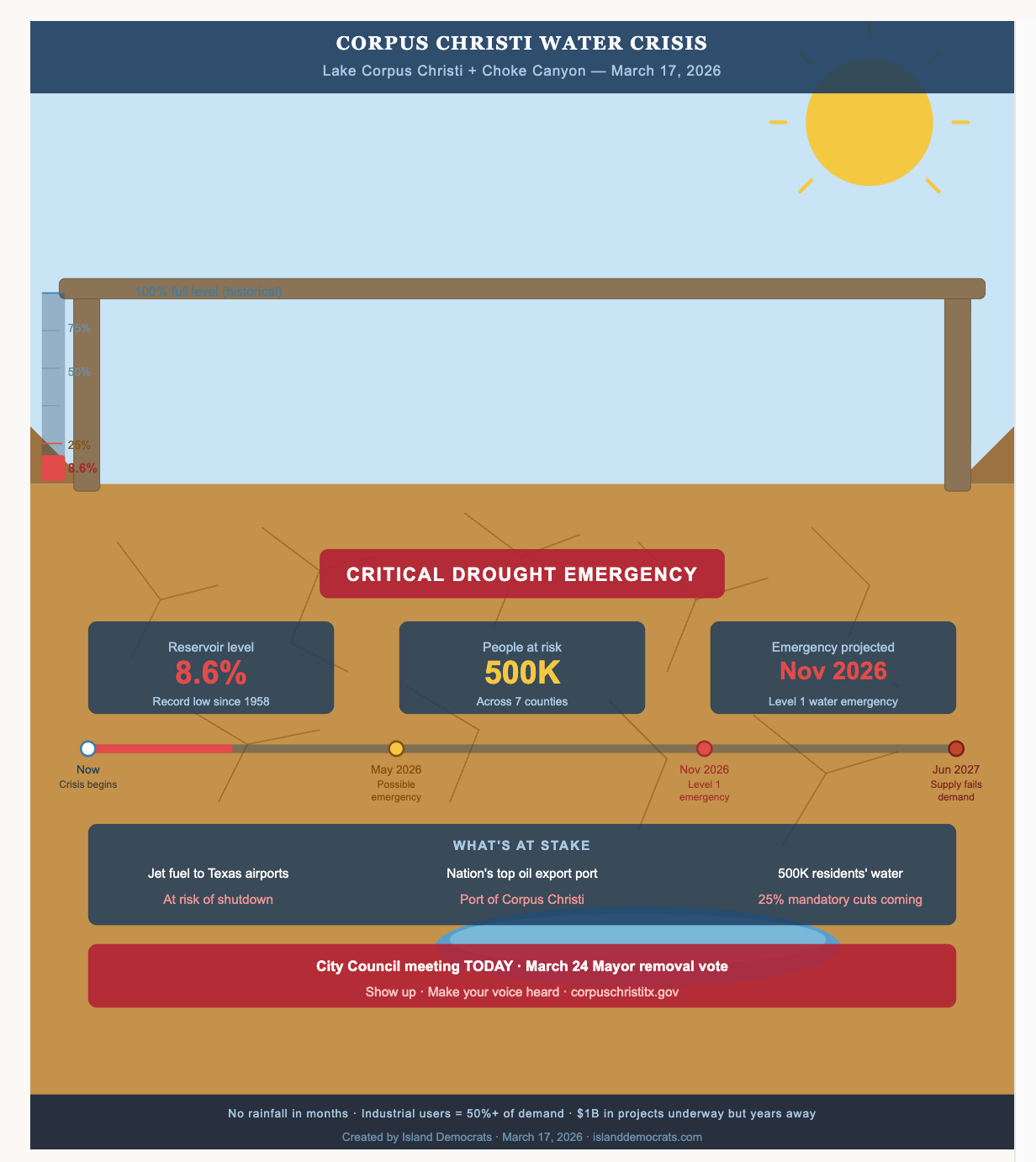
Lake Corpus Christi and Choke Canyon Reservoir have fallen to just 8.4% capacity. Lake Corpus Christi specifically has now dropped to 9.9% of its total capacity — the lowest level since the reservoir was created in 1958. Let that sink in. The lowest level in the reservoir’s entire history.
Lake Texana, which has become the city’s primary backup water source, is currently around 55% full — but is projected to drop to just 30% by summer. The backup plan is also running dry.
The Timeline — Pushed Back But Still Urgent
There is some good news to report since Tuesday. City Manager Peter Zanoni announced two key developments that have bought the city more time. The state approved Corpus Christi to continue pulling water from Lake Texana even if it drops below the 50% threshold that would normally trigger automatic cuts. The city also received a new permit to operate four additional groundwater wells in Nueces County. Together these two moves push a potential water emergency declaration back from May to at least July.
But Zanoni was clear that this is not a solution. “Beginning about last fall, Lake Texana also now began moving into an extreme drought category, so there has been very little inflow into the reservoir.” The backup to our backup is also struggling. We have bought time — not safety.
What Governor Abbott Has Done
Governor Abbott has stepped in with a series of emergency actions. He directed the Lavaca-Navidad River Authority to shift its curtailment threshold — instead of cutting Corpus Christi’s water draw by 10% when Lake Texana hits 50% capacity, cuts will now be triggered at 40%, at which point the reduction would be a steeper 20%. He also ordered the suspension of the “bed and bank” permit requirements that govern how much groundwater the city can pump into the Nueces River, speeding up the emergency wellfield projects that are currently underway.
Abbott has not been quiet about his frustration with local leadership either — calling on the city to make faster decisions or risk state intervention. The political pressure on city council is at an all-time high.
What Comes Next — Two Critical Meetings
Mark these dates. Both of them matter enormously for the future of water on the Coastal Bend.
April 9 — Emergency City Council Meeting Mayor Guajardo has called an emergency meeting specifically to reconsider the Inner Harbor Desalination Plant — the same project the council killed last year amid cost concerns. The project is fully permitted and has received all required approvals. The council will vote on whether to move forward. This is the biggest water vote Corpus Christi has had in years and the entire community should be paying attention.
Mid-April — Revised Water Emergency Timeline Corpus Christi Water will present an updated projected date for a Level 1 Water Emergency based on new wellfield data. This will give the community its clearest picture yet of exactly how much time is left.
The Bottom Line
The city has bought itself a few more months. Emergency orders from Abbott and new well permits have pushed the potential emergency declaration from May to at least July. That is meaningful. But without significant rainfall — which forecasts do not show coming — or a decisive desalination vote on April 9, the crisis clock is still ticking.
April 9 is the most consequential vote the Corpus Christi City Council has had in years. Island Democrats will be watching closely and keeping our community informed every step of the way.
What will happen April 9th? On April 9, 2026, the Corpus Christi City Council will hold an emergency special meeting to address the region’s rapidly depleting water supply.
The Main Agenda: Desalination Vote
The council is expected to reconsider and potentially “fast-track” the Inner Harbor Seawater Desalination Project.
- Reversing a Previous Move: Last year, the city scrapped this project due to its $1.2 billion price tag and environmental concerns regarding salt discharge.
- State Pressure: Mayor Paulette Guajardo called this session following a warning from Governor Greg Abbott, who threatened a state takeover of the city’s water management if local leaders did not act immediately.
- Securing Funds: The city must decide whether to move forward to secure $757 million in low-interest state loans that are currently on the table for this project.
Why the Urgency?
This meeting is a direct response to reservoirs hitting a historic low of approximately 9.5% combined capacity.
- Emergency Thresholds: The council will review new modeling that suggests a Level 1 Water Emergency—requiring mandatory 25% usage cuts—could be triggered as early as May or June 2026.
- Industrial Risk: Officials are also weighing the impact on local refineries and the Port of Corpus Christi, which are critical to the regional economy and require significant water to operate.
A Level 1 Water Emergency is triggered when the city is projected to be within 180 days of running out of water. If declared, it initiates a mandatory 25% reduction in water usage across all customer classes—residential, commercial, and industrial.
Mandatory Residential Restrictions
- Outdoor Watering Ban: All landscape irrigation with potable water is strictly prohibited. This includes sprinklers and irrigation systems.
- Vehicle Washing Ban: Washing cars, motorcycles, boats, or trailers is prohibited.
- Hard Surface Washing: Using water to wash down sidewalks, driveways, parking lots, or buildings (except for fire protection) is banned.
- Pools and Fountains: Filling new or existing swimming pools is prohibited, as is the operation of ornamental fountains unless they use a recirculation system.
Mandatory Industrial & Business Restrictions
- Process Water Only: Businesses are prohibited from using water for any purpose not directly related to their core business process (e.g., no equipment or facility washing).
- Industrial Curtailment: Large-volume industrial users must implement mandatory measures to reduce their consumption by the required 25%.
- Dining: Restaurants are prohibited from serving water to patrons unless specifically requested.
Financial Penalties & Enforcement
- Drought Surcharges: Residential customers will face a $4.00 surcharge for every 1,000 gallons used over a 7,000-gallon monthly limit.
- Fines: Violations can result in fines of up to $500 per incident, per day.
- Service Termination: Repeat offenders (two or more citations) risk having their water service terminated.
As of April 2, 2026, the city’s combined reservoir capacity has reached a historic low of approximately 8.2% to 8.3%.
Individual Reservoir Status
- Choke Canyon Reservoir: Currently at 7.7% full. The water level is over 41 feet below its normal conservation pool.
- Lake Corpus Christi: Currently at 8.6% full. This is the lowest level recorded since the lake was impounded in 1958.
- Lake Texana (Eastern Source): Currently at 51.1% full. While higher than the western lakes, this source is also declining and is projected to drop below the critical 40% threshold by mid-June without significant rainfall.
Why These Numbers Matter
To stretch the remaining supply, the city is currently drawing about 65% to 70% of its water from eastern sources (Lake Texana and the Colorado River).
However, because these eastern sources are also trending downward, the “180-day countdown” to a Level 1 Water Emergency has accelerated. While original estimates placed the emergency declaration in late 2026, current modeling suggests it could now be triggered as early as May or June 2026.
Stay engaged. Stay informed. Your voice matters at city hall.
Follow Island Democrats for ongoing coverage of the Corpus Christi water crisis and all the local issues affecting North Padre Island and the Coastal Bend.
#CorpusChristi #WaterCrisis #CoastalBend #NorthPadreIsland #IslandDemocrats #CCTx #WaterRights #April9 #Desalination #SouthTexas #TexasDrought #NuecesCounty #LakeCorpusChristi #CityCouncil #CorpusChristiWater